
Revision Notes on Basic Geometrical Ideas
Learning Goal
Numbers and it’s types
|
Type of quadrilaterals (6) |
|||||
|
Rectangle आयत |
Square वर्ग |
Parallelogram समान्तर चतुर्भुज |
Rhombus सम चतुर्भुज |
Trapezium समलम्ब चतुर्भुज |
Kite पतंग |
Quadrilaterals
A closed figure bounded by 4 sides is called quadrilaterals.
Four Sides: AB, BC, CD, DA
Four Vertices: A, B, C, D
Four Angle: ∠A, ∠B, ∠C, ∠D
Two Diagonals: AC and BD
Adjacent Sides: Two sides of a quadrilateral which has a common ends point are called adjacent sides.
Ex- AB and BC they have common ends B.
AB and AD, DA and DC, CD and CB
There are four pairs of adjacent sides.
Opposite Sides: Two sides of a quadrilateral which have no common ends point are called opposite sides.
Ex- AB and DC, BC and AD
There are two pairs of opposite sides.
Adjacent Angles: Two angles of a quadrilateral which have a common side are called Adjacent angles.
∠A and ∠B, ∠B and ∠C, ∠C and ∠D, ∠D and ∠A.
There are four pairs of adjacent angles.
Opposite Angles: Two angles of a quadrilateral which have no common side are called opposite angles.
∠B and ∠D, ∠A and ∠C
There are two pairs of opposite angles.
Rectangles: – A quadrilateral whose opposite sides are equal and each angle is 90° is called rectangle.
Properties of a Rectangle
∠P+∠O or∠O+∠N or ∠N+∠M or ∠M+∠P=180°
Formula
- Length of the diagonal of a rectangle = √(L2 + B2)
- Area = L × B
- Perimeter = 2(L+B)
Squares: – A quadrilateral whose all sides are equal and each angle is 90° is called Square.
Properties of a square
∠D+∠E or∠E+∠F or ∠F+∠G or ∠G+∠D=180°
Formula
Length of the diagonal
Perimeter = 4×side = 4L
Parallelogram: – A quadrilateral whose opposite sides are parallel and equal is called parallelogram.
Properties of a parallelogram
(∠M+∠N=∠N+∠O=∠O+∠P=∠P+∠M = 1800)
Formula
Important formulas of parallelograms
Rhombus: – A rhombus is a parallelogram whose diagonals are perpendicular to each other.
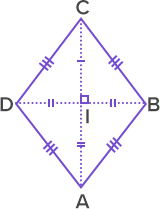
Properties of a Rhombus
Formula
Important formulas for a Rhombus
|
|
Trapezium: – A quadrilateral whose one pair of opposite sides is parallel is called trapezium.
Properties of a Trapezium
Important Formulas for a Trapezium
Area = (Sum of parallel sides) × Height
Perimeter = Sum of all sides = L + L1 + L2 + L3
Summary of properties
|
S.No. |
Property |
Parallelogram |
Rectangle |
Rhombus |
Square |
|
1 |
All sides are congruent |
✕ |
✕ |
✓ |
✓ |
|
2 |
Opposite sides are parallel and congruent |
✓ |
✓ |
✓ |
✓ |
|
3 |
All angles are congruent |
✕ |
✓ |
✕ |
✓ |
|
4 |
Opposite angles are congruent |
✓ |
✓ |
✓ |
✓ |
|
5 |
Diagonals are congruent |
✕ |
✓ |
✕ |
✓ |
|
6 |
Diagonals are perpendicular |
✕ |
✕ |
✓ |
✓ |
|
7 |
Diagonals bisect each other |
✓ |
✓ |
✓ |
✓ |
|
8 |
Adjacent angles are supplementary |
✓ |
✓ |
✓ |
✓ |
Convex and Concave Polygons
The polygons which have all the diagonals inside the figure are known as a Convex Polygon.
The polygons which have some of its diagonals outside the figure also are known as a Concave Polygon.
Regular and Irregular Polygons
Polygons which are equiangular and equilateral are called Regular Polygons i.e. a polygon is regular if-
Hence square is a regular polygon but a rectangle is not as its angles are equal but sides are not equal.
Angle Sum Property
The sum of all the interior angles of a polygon remains the same according to the number of sides regardless of the shape of the polygon.
The sum of interior angles of a polygon is-
(n – 2) × 180°
Where n = number of sides of the polygon
Example
|
Polygon |
Number of Sides |
Sum of Interior Angles |
|
Triangle |
3 |
(3 – 2) × 180° = 180° |
|
Quadrilateral |
4 |
(4 – 2) × 180° = 360° |
|
n-gon |
n |
(n – 2) × 180° |
Remark: This property is applicable to both convex and concave polygon.